Resistors in AI Hardware: Applications in GPUs, Servers and Edge Devices
Resistors in AI Hardware: Applications in GPUs, Servers and Edge Devices
Artificial Intelligence is often discussed in terms of algorithms, neural networks, and software models. However, behind every AI model is a powerful hardware infrastructure that performs the actual computation. From high-performance GPUs to edge AI devices, modern AI systems rely heavily on stable and precise electronic circuits.
Among the many components used in AI hardware, resistors play a critical role in ensuring stable power delivery, signal integrity, and system monitoring. Although resistors do not directly execute AI algorithms, they are essential building blocks in the electronic systems that enable AI computing.
This article explores how resistors are used in AI chips, AI servers, and edge AI devices, and why high-precision resistors are increasingly important as AI workloads continue to grow.
 1. Power Management in AI Hardware
AI computing platforms consume enormous amounts of power. Modern GPUs used for AI training can consume hundreds of watts per chip, and AI servers may require several kilowatts of power.
For example, AI accelerators such as the NVIDIA H100 GPU are designed for high-performance computing and machine learning workloads, which place extremely high demands on power delivery systems.
To maintain stable operation, AI hardware uses several resistor-based circuits for power management.
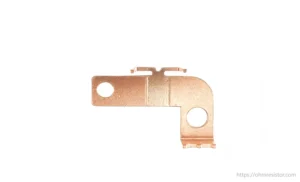
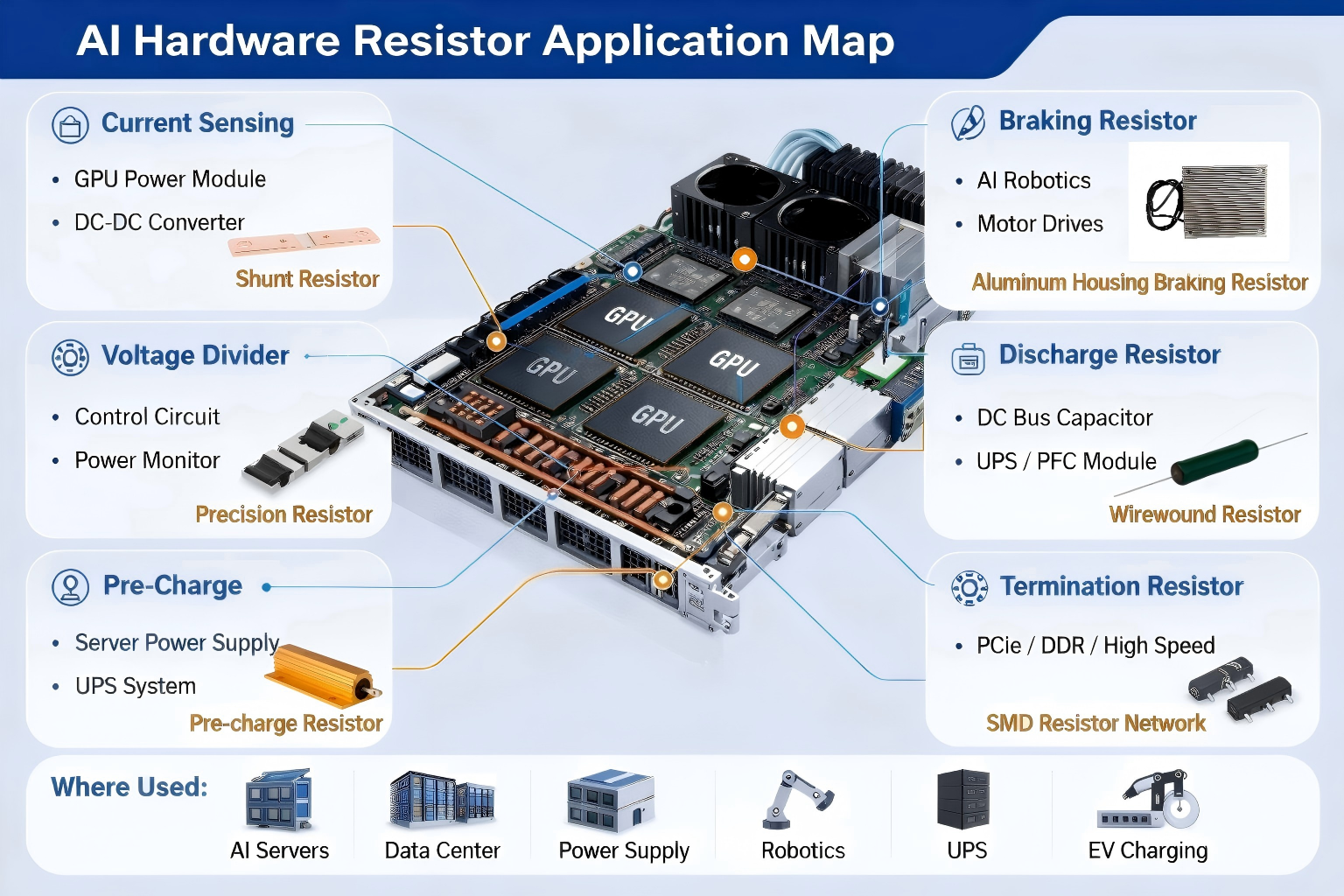
Current Sensing (Shunt Resistors) Resistors in AI Hardware
Precision shunt resistors are widely used to measure current in GPU power modules and DC-DC converters. By monitoring current flow, the system can:
Detect overcurrent conditions
Optimize power consumption
Protect expensive components
Current sensing resistors typically feature:
Ultra-low resistance values (micro-ohm range)
High accuracy
Low temperature coefficient
These resistors are critical for the power management systems used in AI servers and data centers.
Voltage Divider Networks
Voltage divider resistors provide reference voltages for power management ICs (PMICs). These circuits ensure that GPUs, CPUs, and memory receive stable and precise supply voltages.
Voltage divider networks help:
Maintain accurate supply voltage levels
Monitor power rail conditions
Enable system feedback control
Without these resistor networks, precise voltage regulation in high-performance AI hardware would be impossible.
2. High-Speed Signal Integrity
AI computing platforms rely on extremely high-speed communication interfaces to transfer data between processors, memory, and accelerators.
Common high-speed interfaces include:
PCIe
DDR memory buses
high-speed interconnects between processors
Leading chip manufacturers such as Intel and AMD design their platforms with advanced high-speed signaling technologies.
Termination Resistors
In high-frequency digital systems, termination resistors are used to match the impedance of transmission lines. This prevents signal reflections and ensures clean signal edges.
Termination resistors help to:
Maintain signal integrity
Reduce electromagnetic interference
Ensure reliable high-speed communication
In AI servers, termination resistor networks are commonly used in:
PCIe interfaces
memory buses
high-speed communication channels
These resistors are essential for maintaining reliable data transfer in AI computing environments.
3. Sensor Interfaces and Signal Conditioning in Edge AI-Resistors in AI Hardware
Not all AI systems operate inside data centers. Edge AI devices are increasingly deployed in applications such as industrial automation, robotics, and smart surveillance systems.
These systems often process signals from sensors including:
cameras
microphones
temperature sensors
pressure sensors
To convert physical signals into electrical signals that processors can analyze, signal conditioning circuits are required.
Resistor-Based Sensor Circuits
Resistors are used in sensor interfaces for functions such as:
voltage division
signal filtering
Wheatstone bridge circuits
For example, Wheatstone bridge circuits use resistor networks to measure small changes in resistance from sensors. This technique is commonly used in:
strain sensors
pressure sensors
industrial monitoring systems
These resistor networks allow edge AI systems to capture accurate sensor data before it is processed by AI algorithms.
4. Thermal Monitoring and Protection
AI processors generate significant heat during operation, especially in high-performance computing environments.
To prevent overheating and maintain reliability, AI hardware systems rely on thermal monitoring circuits.
Thermistors for Temperature Monitoring
Temperature sensors based on thermistors are widely used in AI hardware systems. Thermistors change their resistance depending on temperature, allowing the system to detect temperature variations.
Thermistor-based circuits can trigger:
cooling fans
liquid cooling systems
system throttling or shutdown
These thermal protection mechanisms are critical in high-density AI servers and computing clusters.
Companies such as Schneider Electric and Vertiv design advanced cooling and power infrastructure systems for modern AI data centers.
5. Why Resistors in AI Hardware Are Critical for Modern AI Systems
As AI computing continues to scale, hardware designers require electronic components with higher precision and stability.
Resistors used in AI infrastructure must meet demanding specifications such as:
low resistance tolerance
low temperature coefficient
high power handling capability
long-term reliability
In particular, current sensing resistors and precision resistor networks are becoming increasingly important as AI systems demand more accurate power monitoring and control.
Conclusion
While AI algorithms often receive the most attention, the hardware infrastructure that supports AI computing relies on thousands of carefully designed electronic components.
Resistors are fundamental elements in these systems, enabling:
accurate power monitoring
stable voltage regulation
reliable high-speed communication
sensor signal conditioning
thermal protection
Without high-precision and reliable resistors, modern AI hardware platforms would not be able to operate safely or efficiently.
As AI computing continues to expand—from cloud data centers to edge devices—the demand for high-performance electronic components, including precision resistors, will only continue to grow