Wirewound vs Thick Film Resistors: Power, Frequency, Thermal and Application Considerations
Introduction
Wirewound vs thick film resistors is an important comparison when selecting the right resistor technology for power electronics design. A resistor is not only a passive component that limits current or dissipates energy — its construction directly affects thermal performance, electrical stability, frequency behavior, and overall system reliability.Selecting the right resistor technology is an important decision in power electronics design. A resistor is not only a passive component that limits current or dissipates energy — its construction directly affects thermal performance, electrical stability, frequency behavior, and system reliability.
When engineers choose between wirewound resistors and thick film resistors, the decision depends on several key factors:
- How much power must be dissipated?
- Is pulse energy involved?
- Does the circuit operate at high frequency?
- How important are temperature stability and long-term reliability?
- Is compact PCB integration required?
Wirewound and thick film technologies each have their own advantages. Wirewound resistors are widely used in high-power applications where energy dissipation and thermal durability are critical. Thick film resistors are preferred when compact size, low inductance, and PCB integration are more important.
The correct resistor technology depends on matching the component characteristics with the actual application requirements.
Understanding the Two Resistor Technologies
Wirewound Resistors for High Power Applications
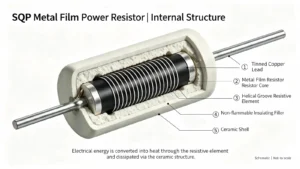
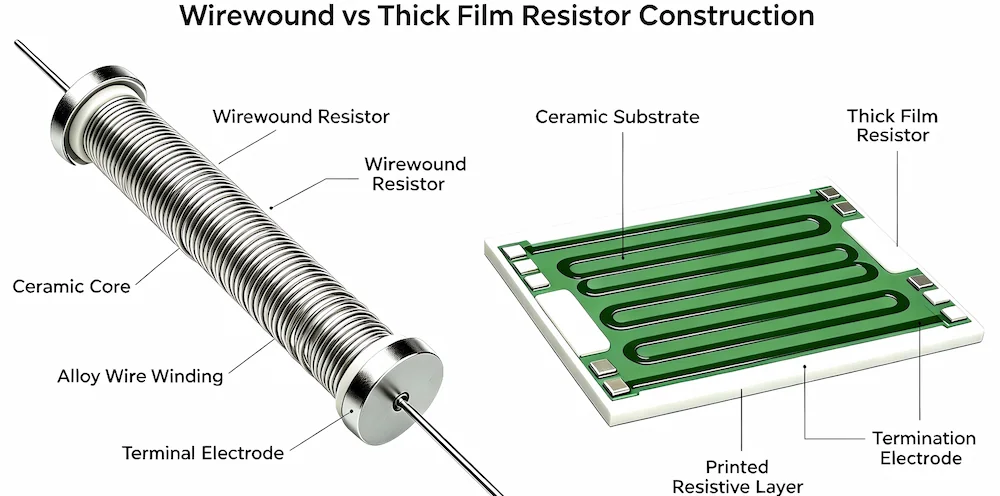
Wirewound resistors are manufactured by winding resistance alloy wire around an insulating core, typically made from ceramic materials.
Common resistance alloys include:
- Nichrome
- Manganin
- Constantan
The final resistance value depends on:
- alloy resistivity
- wire diameter
- winding length
- winding structure
Because the resistance element is made from a metal alloy wire, wirewound resistors provide excellent:
- power capability
- thermal stability
- pulse energy absorption
- long-term reliability
Typical applications include:
- motor braking systems
- VFD drives
- industrial load banks
- power converters
- energy discharge circuits
For applications requiring continuous energy dissipation, wirewound technology remains one of the most widely used solutions.
Thick Film Resistors for Compact and High-Frequency Designs
Thick film resistors are manufactured by printing a resistive paste onto a ceramic substrate and firing the material at high temperature.
The resistive layer typically contains:
- metal oxide materials
- conductive particles
- glass bonding materials
After firing, laser trimming is used to achieve the required resistance value.
The planar structure provides several advantages:
- compact size
- low parasitic inductance
- suitability for PCB assembly
- high-volume manufacturing capability
Thick film resistors are commonly used in:
- control circuits
- switching power supplies
- PCB assemblies
- signal conditioning circuits
- high-frequency electronic systems
Wirewound vs. Thick Film Resistors Comparison
| Parameter | Wirewound Resistor | Thick Film Resistor |
|---|---|---|
| Power Capability | High, from watts to kilowatts | Low to moderate, usually watts range |
| Inductance | Higher due to winding structure | Very low |
| Frequency Response | Limited for standard types | Excellent at high frequency |
| TCR | Very low, precision types can reach low ppm/°C | Moderate, commonly higher than wirewound |
| Stability | Excellent long-term stability | Good for general applications |
| Pulse Capability | Excellent energy absorption | Limited compared with wirewound |
| Size | Larger | Compact |
| Cost | Higher | Lower |
| Manufacturing | More complex | Suitable for high-volume production |
Key Factors Engineers Consider When Selecting Resistor Technology
1. Power Dissipation Capability
The first question engineers need to answer is:
How much energy must the resistor handle?
For high-power applications, wirewound resistors have a significant advantage.
Their construction allows heat to be distributed through:
- resistance wire
- ceramic core
- metal housing or heatsink structure
They are commonly available from several watts to kilowatt-level designs.
Typical applications:
- braking resistors for motor drives
- regenerative energy absorption
- industrial test equipment
- power conversion systems
Thick film resistors are suitable for moderate power requirements, especially where PCB space is limited.
However, they are generally not the first choice for applications requiring large continuous energy dissipation.
2. Thermal Management and Operating Environment
Heat is one of the most important design considerations for power resistors.
The resistor temperature depends on:
- dissipated power
- thermal resistance
- cooling method
- ambient temperature
Wirewound power resistors are often designed with:
- ceramic cores
- aluminum housings
- forced air cooling structures
These designs allow efficient heat transfer in industrial environments.
Thick film resistors rely mainly on:
- ceramic substrates
- PCB copper areas
- external heatsinks
They are excellent for compact electronic designs but require careful thermal management when operated at higher power levels.
3. Frequency Response and Parasitic Inductance
Resistor technology also affects high-frequency behavior.
Because wirewound resistors use a coil-like resistance element, standard designs naturally introduce parasitic inductance.
This can influence:
- switching waveforms
- high-frequency impedance
- transient response
For many low-frequency power applications, this effect is acceptable.
However, in fast-switching circuits such as:
- IGBT applications
- inverter circuits
- pulse power systems
low inductance becomes increasingly important.
Thick film resistors use a flat resistive layer, which provides:
- lower inductance
- faster electrical response
- better high-frequency performance
This makes them suitable for applications where switching speed is critical.
4. Pulse Energy Capability
Some applications do not require continuous power but require the resistor to absorb short-duration energy pulses.
Examples:
- capacitor discharge
- DC link discharge
- snubber circuits
- protection circuits
Wirewound resistors have excellent pulse capability because:
- the metal wire can absorb high energy
- heat is distributed along the winding
- ceramic materials withstand high temperatures
For high-energy pulses, selecting a resistor based only on continuous wattage can lead to incorrect designs.
Engineers should evaluate:
- pulse duration
- peak power
- energy per pulse
- duty cycle
5. Resistance Stability and Temperature Effects
Temperature changes cause resistance variation.
This is especially important in:
- current measurement
- precision control
- feedback circuits
Wirewound resistors using precision alloys can achieve excellent stability and low temperature coefficients.
Thick film resistors provide reliable performance for general electronic applications, but resistance variation under temperature stress and long-term high-load operation should be considered.
For precision applications requiring very stable resistance values, metal element technologies are often preferred.
Wirewound vs Thick Film Resistors: Application Comparison
| Application | Recommended Technology |
|---|---|
| Motor braking resistor | Wirewound |
| VFD drive braking circuit | Wirewound |
| Industrial load bank | Wirewound |
| DC discharge resistor | Wirewound / Thick Film |
| IGBT snubber circuit | Low inductance thick film |
| High-frequency power circuit | Thick Film |
| PCB control circuit | Thick Film |
| Precision current sensing | Metal alloy / Shunt resistor |
How to Choose the Right Resistor Technology
A practical selection approach:
Choose Wirewound Resistors When:
- High power dissipation is required
- Continuous energy absorption is needed
- Pulse loads are significant
- Thermal reliability is critical
- Industrial environments are involved
Typical examples:
- motor drives
- elevators
- cranes
- industrial automation equipment
Choose Thick Film Resistors When:
- PCB space is limited
- Low inductance is important
- Switching frequency is high
- Moderate power is required
- Surface mounting is preferred
Typical examples:
- inverter control boards
- power electronics modules
- switching circuits
Many Modern Designs Use Both Technologies
Modern power electronics systems often combine different resistor technologies.
For example:
A motor drive may use:
- thick film resistors in the control PCB
- shunt resistors for current measurement
- wirewound resistors for braking energy absorption
Using different resistor technologies for different functions allows engineers to achieve the best balance between:
- performance
- reliability
- cost
- system size
Conclusion
There is no universally superior resistor technology.
Wirewound resistors provide advantages in:
- high power handling
- thermal performance
- pulse capability
- long-term stability
Thick film resistors provide advantages in:
- compact size
- low inductance
- PCB integration
- high-frequency performance
The best choice depends on the electrical, thermal, and mechanical requirements of the application.
For industrial power electronics, selecting the correct resistor technology at the beginning of the design process helps improve reliability, reduce thermal issues, and avoid unnecessary redesign.
Apply this to your component selection
For a specific project, share your part number or drawing, quantity, and key operating conditions. We can help review your requirements and coordinate with our manufacturing resources.