Braking Resistor Power and Thermal Design Guide for Inverters, Power Supplies, and Energy Storage Systems
Braking Resistor Power and Thermal Design Guide for Inverters, Power Supplies, and Energy Storage Systems
How to Calculate Braking Resistor Power Quickly
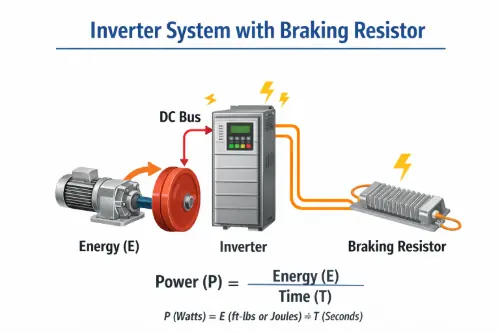
Choosing the right braking resistor starts with calculating power. The core idea is simple: how much energy you need to dissipate and how fast you need to do it.
Step 1 – Basic Power Calculation
1. Determine the energy in the load (ft-lbs or joules).
2. Define the time period to dissipate this energy.
3. Calculate power: Power (W) = Energy / Time.
Example: If your load has 5000 ft-lbs of energy and you want to dissipate it in 5 seconds, the calculated wattage is your minimum braking resistor power.
MegaResistors Braking Resistor Calculator
Step 2 – Include Gearbox Advantage
If your system uses a gearbox, remember to factor in the mechanical advantage:
“Don’t forget your gearbox advantage—it changes the actual energy delivered to the resistor.”
Thermal Design Parameters of Braking Resistors
Once you know the power, thermal design ensures safety and reliability.
Resistor Rating and Time Period
Braking resistors are rated for a specific number of watt-seconds over a time period (e.g., 100,000 W·s per 5 minutes). This rating ensures the resistor can safely absorb energy during stops.
Thermal Mass Consideration
Resistors have thermal mass, which allows them to store energy and dissipate it over a longer period than the braking event:
“The resistor’s thermal mass can soak up watt-seconds and release heat gradually.”
Oversizing for Safety
Many engineers prefer to slightly oversize the resistor:“More is better—choosing a slightly bigger resistor ensures reliability and avoids overheating.”
Practical Tips and Alternative Solutions
Consider Regeneration or Common Bus Systems
If your drive supports energy regeneration or common bus connections, you can reduce the load on braking resistors:
“Other options include regeneration within the drive, a separate regen unit, or common bus systems.”
Consult Experts When Unsure
When in doubt, reach out to your drive manufacturer:
If you’re not sure, contact the manufacturer. If something fails, you have someone to rely on.
FAQ – Common Questions About Braking Resistors
Is the power calculation complicated?
Not really. Just remember: Power = Energy / Time. Online calculators make it faster.
How do I interpret thermal design ratings?
Look at watt-seconds per time period. Ensure thermal mass is sufficient; oversize if needed.
Does the gearbox affect sizing?
Absolutely. Gear ratios change the energy delivered to the resistor—don’t ignore it.
Can I rely solely on regeneration instead of a braking resistor?
Depends on your system. Regeneration or a common bus can reduce resistor load, but safety redundancy usually requires a resistor.
How do I choose a braking resistor quickly?
Calculate power and thermal ratings → select slightly oversized resistor → choose supplier → check compatibility with your drive.